
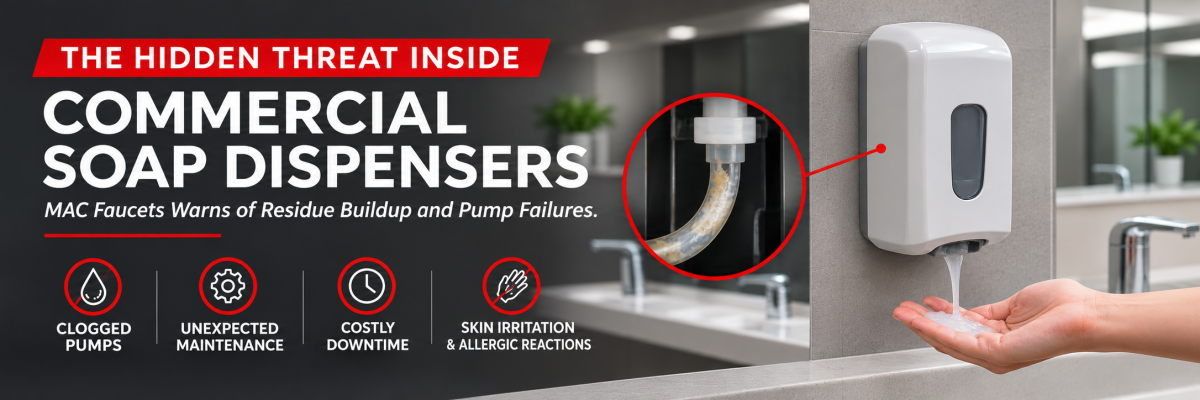
The Hidden Threat Inside Commercial Soap Dispensers: MAC Faucets Warns of Residue Buildup and Pump Failures
By Electronic Faucets - 11/11/2026 - 0 comments
The Hidden Threat Inside Commercial Soap Dispensers: MAC Faucets Warns of Residue Buildup and Pump Failures
What happens when two different soaps meet inside a dispenser? The answer is: Clogged pumps, Unexpected maintenance, Costly downtime, and far-far more
PARAMOUNT, Calif. — A commercial soap dispenser may look perfectly clean and functional on the outside while trouble is brewing deep inside its pumping system.
Everyday, facility maintenance teams replace soap products, change suppliers, and service dispensers. But there is one important detail which often goes unnoticed: the old soap doesn't simply disappear when a new soap enters the system.
Small amounts of soap remain trapped inside internal tubing, pump chambers, valves, and dispensing nozzles. When a different soap formula passes through those same components, the two products can come into contact. And that's where trouble begins.
Two Soaps + One Pump = Guaranteed Problem.
Not all commercial soaps are formulated the same way.
Some are thick. Others are thin. Some contain moisturizers, fragrances, or other additives. Others are specifically designed for foaming dispensers or particular pumping mechanisms.
When residue from one formula meets another inside a dispenser, the mixture may behave differently from either soap on its own.
Depending on the formulations involved, the result can include:
-
Thickening or gel-like buildup: Changes in consistency can restrict narrow passages and interfere with pumping. This results in reduced or even stoppage of soap flow
-
Foaming problems unique to foaming type dispensers: Incompatible formulations or altered viscosity can prevent foaming systems from working as intended.
-
Premature component replacement: Persistent blockages or incompatible products may contribute to pump problems over time.
Canary in the Coal Mine: When Soap Mixing Becomes a Skin Safety Concern
A clogged pump is an inconvenience. But what happens when the soap coming out of that pump is no longer the same product that went in? When residue from an old soap meets a different formulation inside the tubing and pumping system, the result is an untested combination of ingredients. Different soaps may contain fragrances, preservatives, surfactants, and other additives that were never intended to be combined. While mixing soaps does not automatically create a harmful chemical reaction, it can introduce uncertainty about the product being dispensed. Certain soap ingredients are already known to cause skin irritation, dryness, redness, itching, and allergic contact dermatitis in susceptible individuals. The real concern is that users may unknowingly be washing their hands with a mixture whose compatibility and effects on skin have never been evaluated.
Even more alarming, the concern may extend beyond chemical compatibility to hygiene itself. Residue trapped inside poorly maintained dispensing systems can create conditions where microbial contamination becomes a concern. The Centers for Disease Control and Prevention (CDC) warns that improper refilling of liquid soap dispensers has been associated with outbreaks involving harmful bacteria. Imagine washing your hands to remove germs, only to discover that the dispenser itself may be introducing contamination. This is why MAC Faucets urges facility managers to take soap compatibility, internal pump cleanliness, and proper maintenance seriously. A malfunctioning pump can be replaced. Protecting the people who rely on that dispenser should always come first.
The Problem May Start Long Before the Dispenser Stops Working
A dispenser doesn't always stop functioning without warning.
Signs may begin by delivering smaller amounts of soap. The pump may cycle without producing the expected output. A foaming dispenser may begin producing watery soap, or just bubbles, instead of consistent foam.
These symptoms may be mistaken for an empty soap bottle, a low battery, or a worn-out pump. The actual problem, however, may be hidden inside the system.
For facilities operating dozens or hundreds of dispensers, small maintenance problems can quickly become a much larger operational headache.
What Facility Managers Should Do Before Their Next Soap Change
MAC Faucets encourages commercial facility operators to treat soap refill and compatibility of soaps used as an important part of preventive maintenance, not simply a janitorial task.
Before introducing a different soap formulation:
-
Check the dispenser manufacturer's specifications. Not every pump is compatible with every soap.
-
Identify the existing soap. Find out what was previously running through the system.
-
Inspect the tubing and pump. Look for restricted flow, deposits, or inconsistent dispensing. This is a good time to check for line cracking and damage.
-
Follow this highly recommended cleaning procedure: Flush internal soap dispenser components by filling an empty soap bottle with hot water from the sink faucet, and running the soap dispenser pump continuously for one full minute. Do not heat the water over the stove for this purpose as this may damage the internal components. With MAC Faucets soap dispenser, this task is accomplished by depressing the priming button located at the soap dispenser pump housing.
-
Important advice for cold temperature locations: Temperature has a huge impact on soap stability and viscosity. Certain formulations may separate or develop uneven consistency. Moreover, soap may not move easily through dispenser tubing or pump mechanisms, or simply stop dispensing. These conditions are reversed when temps rise again. It is highly advisable to mix water to your soap bottle if the soap dispenser is subjected to low temp conditions. This will help with better dispensing, albeit may not have an impact on reducing separation issues within the soap formula itself.
Don't Wait for a Pump Failure to Investigate
A functioning dispenser today is not proof that its internal tubing and pumping system are free of residue.
The next time a facility changes soap suppliers, soap formulations, or soap brand, maintenance teams should consider what may still be inside the dispenser.
Because the problem isn't always the soap being added. Sometimes, it's the soap left behind.
For more information about commercial soap dispensing systems and preventive maintenance, visit www.macfaucets.com.
About MAC Faucets
MAC Faucets designs and manufactures commercial automatic faucets, soap dispensers, flush valves, and matching restroom accessories. The company focuses on developing reliable and highly stylized products for commercial restroom environments.
Media Contact: MAC Faucets
Website: www.macfaucets.com
Email: info@macfaucets.com
Sources:
American Academy of Dermatology Association. “Eczema Types: Contact Dermatitis Causes.” American Academy of Dermatology, www.aad.org/public/diseases/eczema/types/contact-dermatitis/causes. Accessed 11 Nov. 2026.
Bobrick Washroom Equipment, Inc. “TB-107: Cleaning and Maintenance for Bobrick B-824 Automatic Counter-Mounted Soap Dispensers.” Bobrick, revised 19 June 2020, www.bobrick.com/wp-content/uploads/TB-107.pdf.
Bradley Corporation. Terreon Washfountain: Installation Manual for Models TDB3103 and WF3203. Bradley Corporation, www.bradleycorp.com/download/1277/wf1332.pdf. Accessed 11 Nov. 2026.
Centers for Disease Control and Prevention. “Clinical Safety: Hand Hygiene for Healthcare Workers.” CDC, 27 Feb. 2024, www.cdc.gov/clean-hands/hcp/clinical-safety/.
Delta Faucet Company. Commercial Soap Dispenser: Model DESD-75—Maintenance and Installation Instructions. Delta Faucet, www.webstaurantstore.com/documents/pdf/26adesd751_instructions.pdf. Accessed 11 Nov. 2026.
U.S. Food and Drug Administration. Supplement to the 2022 Food Code. Dec. 2024, www.fda.gov/media/183271/download.
World Health Organization. “Skin Reactions Related to Hand Hygiene.” WHO Guidelines on Hand Hygiene in Health Care, World Health Organization, 2009, www.ncbi.nlm.nih.gov/books/NBK144008/.